
Risk Analysis
Risk analysis is a structured, science-based process that helps to provide the rationale for implementing management measures or policy decisions. It is also used to manage uncertainty, helping decisions to be made when scientific information is incomplete. Information used to undertake risk analysis can be qualitative or quantitative, ranging from published scientific literature, to grey literature, to expert judgement.
Previously, risk analysis for the island of Ireland has comprised of (at least):
- Hazard identification (previously in Ireland provided by the Invasive Species Ireland (Kelly et al 2013[1]); and horizon scanning (Lucy et al 2020[2]), used to identify species likely to be a threat;
- Prioritisation of effort (previously in Ireland provided by the Invasive Species Ireland prioritisation exercise (Kelly et al 20131));
- Risk assessment, used to assess the likelihood and severity of the threat (Kelly et al 20131, Inland Fisheries Ireland and National Biodiversity Data Centre 2014[3]), risk assessment of non-indigenous marine species, Ireland (Minchin, 2014[4]); and
- Risk communication, how the results of risk analysis are summarised and accurately communicated.
The Components of Non-native Species Risk Analysis
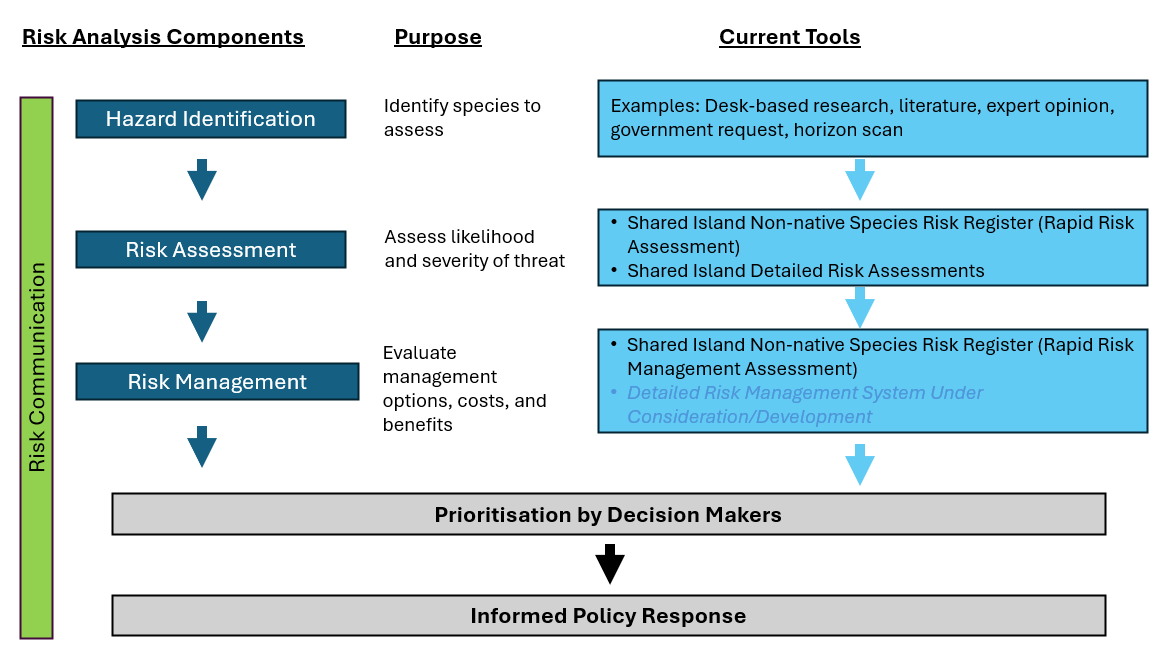
A graphic to illustrate the elements of the current island of Ireland’s risk analysis is provided below.
Invasive and Non-native Species Risk Assessments
Funded by the Shared Island Biosecurity and Invasive Species Initiative, a review of the methods and processes for invasive and non-native species risk assessment on the island of Ireland is being conducted. During a programme of work spanning from 2025 to 2029, species will be prioritised for assessment, and a new series of both rapid and detailed risk assessments will be produced.
Under this initiative. a new template for conducting non-native species detailed risk assessments has been developed: Shared Island Detailed Non-native Risk Assessment Template, along with guidance for authors of the assessment: Guidance document for Shared Island Detailed Risk Assessments.
To support a risk analysis framework on the Island of Ireland, an Invasive and Non-native Species Risk Analysis Advisory Panel (IN-RAP) of experts has been formed. The remit of the group includes ensuring that risk assessments are robust, evidence-based and fit for purpose.
New risk assessments will be be published as they become available, alongside previous species risk assessments here: Risk Assessed Species.
References
[1] Kelly, J., O’Flynn, C., and Maguire, C. 2013. Risk analysis and prioritisation for invasive and non-native species in Ireland and Northern Ireland. A report prepared for the Northern Ireland Environment Agency and National Parks and Wildlife Service as part of Invasive Species Ireland. https://invasivespeciesireland.com/wp-content/uploads/2013/03/Risk-analysis-and-prioritization-29032012-FINAL.pdf
[2] Lucy FE et al (2020) Horizon scan of invasive alien species for the island of Ireland. Management of Biological Invasions 11(2): 155–177, https://doi.org/10.3391/mbi.2020.11.2.01
[3] Inland Fisheries Ireland and National Biodiversity Data Centre 2014 https://invasives.ie/risk-analysis/
[4] Minchin, D. (2014). Risk assessment of non-indigenous marine species, Ireland: Including those expected in inland waters (Report No. NIS-2014#1). Marine Organism Investigations. Report undertaken for The Centre for Environmental Data and Recording (CEDaR), Department of Natural Sciences, National Museums Northern Ireland (NMNI), and the Department of Arts, Heritage and the Gaeltacht. https://invasives.ie/app/uploads/2022/03/NIS-Risk-in-Ireland-2015.pdf